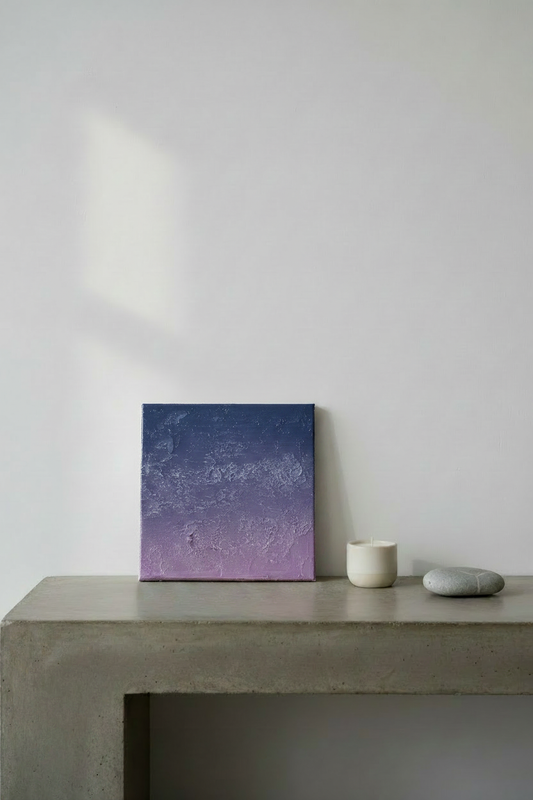
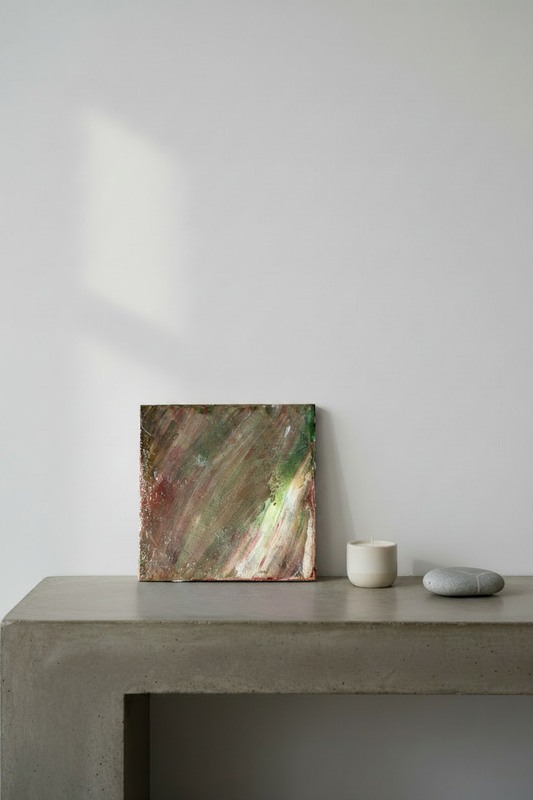
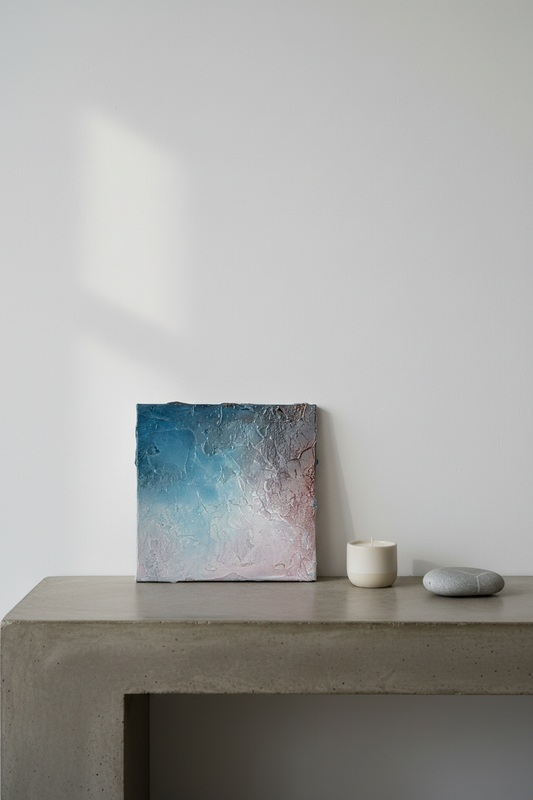
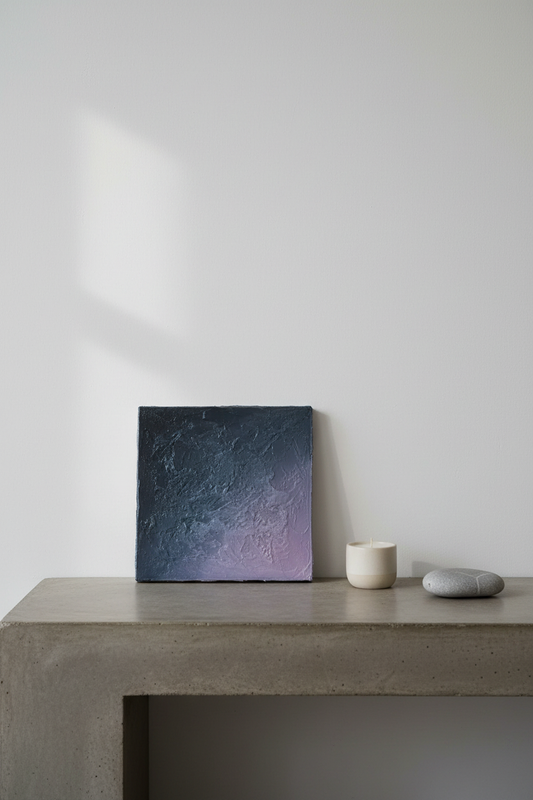
Works that you don't just see, but also feel. The Relief. collection consists of original mixed media paintings with a lasting rubbery silicone relief — a surface that reacts to light and changes with its environment.
See and Feel
Each work in the Relief. collection begins with acrylic paint, built up layer by layer on canvas. Then comes the silicone — not mixed, but applied as separate layers on top of the dried surface. The result is a tactile relief that remains rubbery to the touch. Soft, alive, never hard.
Because the light always falls differently on the relief, each work looks different during the day than in the evening. It changes with every light source in the room. Touching is not an afterthought — it is part of the work itself.
I create these works because I want art to be more than just something you hang on a wall. It should do something with the space, with the light, with you. The silicone makes that possible in a way paint alone never can.
— Jordy Koumans, KOJO Art
What is silicone in painting?
Silicone is a synthetic material used in visual arts to create texture, relief, and organic patterns. Unlike acrylic mediums, silicone does not dry hard — it remains flexible and rubbery, even after years. This makes it unique as an artistic material.
In the Relief. collection, I use silicone not as a binder or an additive to the paint, but as an independent layer on top of the dried painting. The silicone contracts during the curing process, forming the characteristic cracked, cellular patterns that give each work its own character.
The result at first glance resembles a geological formation, a skin texture, or frozen water — organic, unpredictable, and never twice the same.
The Process: How is a Relief. Work Created?
Step 1 — The paint layers
The work begins with acrylic paint on canvas. Layer by layer, built up and dried. The color, composition, and transition are determined at this stage. This is the painting itself — the foundation on which everything rests.
Step 2 — The silicone
Once the paint is completely dry, I apply the silicone as separate layers on top of the surface. The silicone is transparent and follows the color of the paint underneath, but adds its own dimension: depth, texture, movement.
Step 3 — Curing
During curing, the silicone contracts and forms organic, cellular patterns. This process is partly controllable, partly unpredictable. Each work is therefore unique — even if I were to repeat the exact same steps, the result would always be different.
Step 4 — The final result
The work is finished when the silicone has fully cured and the relief is stable. The surface remains rubbery to the touch — soft, flexible, tactile. The work is signed, dated, and ready to go out into the world.
Silicone Painting vs. Regular Acrylic Painting
What makes a Relief. work different from a traditional acrylic painting?
Texture. An acrylic painting can have texture through brushstrokes or pastes, but the surface is always hard. A silicone relief is permanently soft and flexible — you feel the difference immediately.
Light reflection. The three-dimensional cell structure of the silicone reflects light in a way a flat painting never can. The work literally changes with the time of day and the position of the light source.
Touching. An acrylic painting is made to be looked at. A Relief. work is made to be felt. That is a fundamentally different starting point.
Uniqueness. Each silicone relief is unrepeatable. The patterns that emerge during curing are never identical — not even with the same artist, with the same materials, on the same day.
What you get with every Relief. work
Tactile relief. A lasting rubbery silicone surface — made to be felt.
Living light. The work changes with every light source in the room. Different during the day than in the evening.
Mixed media. Acrylic paint on canvas with silicone — a combination of painting and sculpture.
Painted edges. Ready to hang, no frame needed.
Hand-painted and signed. By Jordy Koumans, unique original.
Worldwide shipping. Carefully packaged, with track & trace.
Maintenance and Care
A Relief. work requires little maintenance, but a few things are good to know:
Dust removal. Use a soft, dry cloth or a brush. No wet cloths or cleaning agents on the silicone surface.
Light and heat. Do not hang the work in direct sunlight or near a heat source. Silicone is stable, but extreme temperature fluctuations are not ideal for any artwork.
Touching is allowed. The relief is made to be felt. Touching with clean hands is fine — it's part of the experience.
Frequently Asked Questions
What exactly is the silicone relief?
Silicone is applied as separate layers on top of dried acrylic paint. It creates an organic, cracked pattern that remains rubbery to the touch — never hard, always tactile.
Does the work really change with the light?
Yes. Because the relief is three-dimensional, light always falls on it differently. In daylight, you see different shadows and reflections than with artificial light in the evening. The work is different at every moment of the day.
Is a silicone painting durable?
Yes. Silicone is a stable, long-lasting material that does not yellow, crack, or harden. The rubbery texture is retained — even after years.
Do I need a frame?
No. The edges are painted, so the work can be hung directly without a frame. A frame is possible — contact us for options.
Is worldwide shipping available?
Yes — KOJO Art ships worldwide. Each work is carefully packaged and sent with track & trace. Within Europe, delivery usually takes 3 to 7 business days.
Related Collections
About KOJO Art — KOJO Art is the brand name under which I, Jordy Koumans, paint and sell. Each work is handmade in my studio in Tilburg. Shipped worldwide.